 Facebook
 Twitter
- UNG
is NOT a double inverse fund - Dancing
the contango - How
to play the trend
I’ve been teasing a full write up on why I
think the United States
Natural Gas ETF (NYSE: UNG) may have
been designed to lose money. If you’ve
had the misfortune of owning this ETF, you are keenly aware of this
tendency. In the past 9 months, the
price of natural gas climbed off the floor of $2.75 per thousand cubic feet up
to nearly $4.25 today. That’s a 55%
gain. In that same time period, UNG lost
27%.
As a reminder, UNG is NOT a double inverse ETF, but you
wouldn’t know it from looking at those results. That brings me to crux of why this ETF does not perform the way you
might expect it to, and how you can avoid making investments in similar ETFs that
are more tar-pit than gold-mine. After
all, the first rule of investing is “Don’t lose money.”
Investors typically think of ETFs as baskets
of equities, with performance naturally reflect the rise or fall of the value
of those stocks. UNG is structured a
bit differently than other ETFs available to the public. According to the United
States Natural Gas fund website:
"The
investment objective of UNG is for the changes in percentage terms of the
units’ net asset value to reflect the changes in percentage terms of the price
of natural gas delivered at the Henry Hub, Louisiana, as measured by the
changes in the price of the futures contract on natural gas traded on the New
York Mercantile Exchange that is the near month contract to expire, except when
the near month contract is within two weeks of expiration, in which case it
will be measured by the futures contract that is the next month contract to
expire, less UNG’s expenses."
Okay, that’s a mouthful.
In other words, the value of the fund is
driven by front month natural gas futures exposure. To ensure continuous
exposure, the fund’s administrators "roll" their front month futures
contracts to the next month as expiration approaches to avoid taking physical
delivery. Many ETF investors incorrectly assume that UNG attempts to track the
return of natural gas spot prices – but this couldn’t be further from the
truth.
To explain this process further, I’ve enlisted the
help of one of the best traders I know: Eric Adamowsky.
Eric explains:
”The primary
reason UNG experiences such large losses EVEN when natural gas prices rise is
the fact that the natural gas market is usually in contango. Contango is just a
fancy word that describes a situation where the future prices of natural gas
are higher than the spot prices. UNG
fund managers are forced to sell near month contracts (also known as
"rolling" contracts) for less than the cost of back month, or
second-month futures. This inevitably results in a loss of exposure to natural
gas. The UNG fund more or less pays a
"premium" to roll the contracts to the next near month to avoid
taking physical delivery. Every time they buy the next front month and
sell the current month natural gas future, they do so at a loss when prices are
in contango – which they usually are!
Contangoed
markets are generally a result of higher storage costs, as in the case of
natural gas which has extremely high storage costs. Higher future price
expectations from market participants also cause a market to become contangoed Whereas a barrel of oil can sit in a barrel
in perpetuity, if you want to store natural gas you need miles of pipeline and
humongous high-tech gas storage tanks. It
might be the most expensive commodity to store, so there are very few
circumstances when it’s not in contango.”
Here’s a table of contangoed nat gas prices:
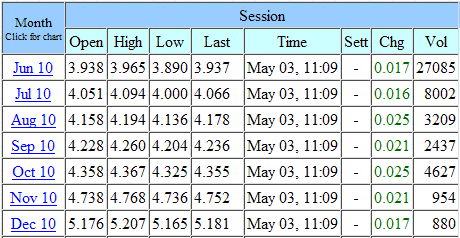
Looking at this chart, you might think
“Well, I’ll buy the June future at $3.93 and sell the December contract for
$1.25 profit.”
That’s a common misconception – but what
really happens is that as you get closer to December, that contract will go
down in value. Unless there’s a huge
supply crunch or some other market disruption, your December contract will
probably come within pennies of what you paid for the June contract, as future
contract prices eventually settle to spot price levels.
Furthermore, unless you can invent a way to
store one thousand cubic feet of natural gas for free for the next 7 months, your
storage costs will gobble up any price appreciation. That’s contango: natural gas costs more in
the future, not because prices are going to necessarily go up – but because
it’s expensive to store natural gas for any period of time. The longer you hold the contract, the more
you’re paying for that storage. Natural
prices could go up, and if you own the December contract you could certainly
make some money, but prices would have to appreciate MORE than the current
contango discrepancy of $1.25.
Of course, I don’t advocate buying and
rolling natural gas futures – but that’s exactly how UNG is structured. For whatever reason, the fund is set up so
that the ONLY way it can turn a profit is if prices are not in contango, that
is, if front month prices are higher than subsequent month prices.
It can happen, and when it does, it’s called
backwardation, and it’s the result of unexpected supply and demand action in
the market for natural gas. On the inverse, if the natural gas futures are in a
state of backwardation, UNG may actually benefit from this condition. I don’t know about you, but I want to make
money from the expected, not the unexpected.
I do expect natural gas prices to rise in
the future – but UNG is not the way to take advantage of the trend. It’s counter-weighted to resist
profitability. ETFs can be a great way
to gain exposure to a variety of sectors, and not all of them are designed to
lose money, but you owe it to yourself to read and understand how they are
designed. If you don’t understand how
they’re set up for profitability, it just might be that they’re not going to be
profitable.
I’d also advise against investing in an ETF
that trades futures – unless you feel like you have a strong grasp on how they
work. Not to get into too much detail,
but every futures contract is a derivative – and some ETFs will trade options
on those contracts – which means they’re trading derivatives on
derivatives.
Why make it so complicated?
If you’re bullish on natural gas, for
instance, I recommend buying strong natural gas companies at cheap
valuations. In the Energy
World Profits portfolio, we’re currently recommending the largest
independent natural gas company in the U.S. This company has the most natural gas, with
the most active wells, and will stand to benefit immensely from any upside in
natural gas prices. If you’re interested
in finding out the name of this company, I’d like to give you a free trial
subscription to Energy World Profits. You can take me up on this offer by clicking
here now.
Good investing,
Kevin McElroy
Editor
Resource
Prospector