

Request Your FREE Special Report Today:
"Top 10 Forever Stocks for Creating Wealth"


(privacy policy)

Request your FREE Special Report today and you'll
also receive a complimentary 6-month subscription
to our Daily Profit investment newsletter.

The Dollar vs. a Freight Train

 print 

  • Will five billion people die?
  • Peak oil production is in our rearview
  • Get out of the way!

Michael Ruppert tacitly believes that five billion people will be wiped off the face of the earth sometime in the next few decades.

His proof? One chart.
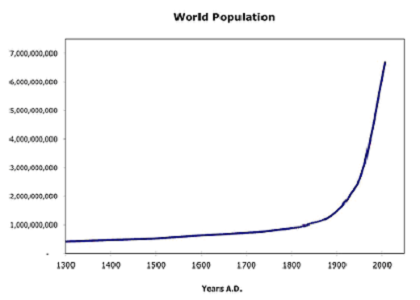

Ruppert makes the unappealing but hard to refute argument that human population growth is a direct and total result of the existence of cheaply available crude oil.

You can see his entire argument laid out in the chilling documentary “Collapse.”

But in short, Ruppert posits that population growth from 1900 to 2000 was almost entirely the result of a steady supply of crude oil.

For the record, we have likely passed the point of peak oil production. I know there are some people out there who don’t agree with that statement. Some of them might even be reading this letter right now. But in the oil exploration and production industry, there is little argument. There just isn’t.

If you have any proof that we have yet to hit peak oil production (in other words, you have oil production numbers that are on the rise, not on the decline) then I’d love to see it.

With peak oil production in our rear-view, we will necessarily produce less oil in the future - until eventually oil is too expensive to bring to market.

Without crude oil to fuel ongoing growth in industrialization, technology, commerce and agriculture, the five billion people on this earth who only exist because of crude oil will die.

That’s his argument, anyway.

He claims that we’ve currently only seen one side of the bell curve - the growth side, and that sometime in the next few decades, we’ll see the other side: the decline side.

I don’t know if I agree with him completely.

I do think that his basic facts are correct: oil is a dwindling resource. We’re not running out of oil, for the record, but we are running out of the cheap oil.

Oil’s going to get much, much more expensive - and not just because it’s getting more expensive to pump out of the ground. It’s getting additionally expensive, because, - to paraphrase Energy Economist Jeff Rubin, governments around the world are trying to spur growth by replacing cheap oil with cheaper and cheaper currencies.

It’s not a situation that can last forever, or even very long.

Why? Well, to belabor the point, you can’t put paper dollars into a diesel truck to run the engine to deliver strawberries from California to Chicago. You can’t turn paper dollars into plastic to wrap around strawberries. You can’t squeeze fertilizer out of paper dollars to grow those strawberries either.

More to the point, you can’t create enough ones and zeros in a Federal Reserve computer to trick the universe into believing that an idea about moving a ton of goods across the world is the same thing as actually doing it.

I know, I know: they have really fancy computers at the Federal Reserve. Their ones and zeroes are arguably some of the best ones and zeroes ever conceived by man. They’re certainly better than European ones and zeroes.

But ones and zeroes necessarily CAN’T put bread on the table for very long. Not unless they’re backed by actual resources, output, labor, energy, etc. that actually exist.

The dollar is frequently referred to as the tallest midget in a room full of midgets.

But oil is a giant and the dollar can’t win.

So my advice is to trade in your dollars (which become more and more worthless every year) and get yourself access to energy securities, physical gold and silver, agriculture securities, and gold and silver mining companies.

As much as possible, you want to shield yourself from the effects of the collision between the dollar and oil.

Even if five billion people don’t die, it’s still going to be a bumpy ride for people who bet on the dollar AGAINST oil.

Good investing,

Kevin McElroy

Editor

Resource Prospector